
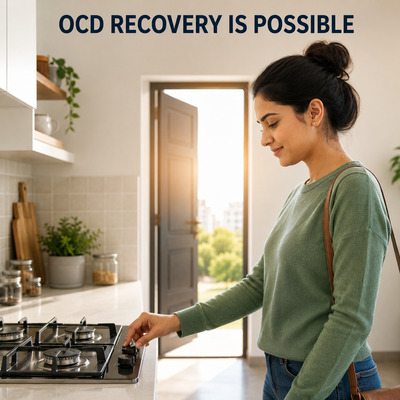
Riya was 27, successful, and secretly exhausted. Every morning before leaving for work, she checked the gas knob eleven times, not because she wanted to, but because her mind told her something terrible would happen if she didn’t. She called it a “habit.” Her family called it “being careful.” It was neither. It was OCD. For 12 years, she suffered in silence before a colleague mentioned OCD treatment in Gurgaon. That one conversation changed everything. Today, after structured OCD therapy in Gurgaon, Riya checks the knob once ,and walks out the door. This is her story.
For educational purposes only. Not a substitute for professional medical advice.
The Morning Ritual Nobody Knew About
Every weekday morning, Riya’s alarm rang at 6:15 AM. By 8:30 AM, she was supposed to be in her car, driving to her corporate job in Gurgaon’s Cyber City. But most mornings, she left home by 9:15 AM — sometimes later — her eyes red, her hands trembling slightly, her mind in a state of exhausted defeat.
The forty-five minutes in between were not spent on breakfast, or getting dressed, or scrolling her phone. They were spent at the kitchen gas knob.
Check. Is it off? Yes. But what if it isn’t? Check again. It is off. Walk to the door. But what if I didn’t check properly? Walk back. Check. Count to three. What if I miscounted? Check again.
Eleven times. Always eleven. If she lost count, she had to start over.
Riya knew it made no sense. She was a data analyst — logical, precise, trained to trust evidence. And yet, the moment she turned away from that knob, an invisible wave of dread would crash over her. A vivid, unwanted image — fire, smoke, her apartment in ruins, her neighbours harmed because of her negligence. The only way to make the image stop, even temporarily, was to check again.
She had been doing this for over twelve years.
“Everyone Has Their Quirks”
Riya did not tell anyone for a long time. When she was occasionally late to work, she blamed traffic. When her mother noticed she was taking unusually long to leave the house during a family visit, Riya laughed it off — “You know me, always double-checking everything.”
Her mother nodded approvingly. “Better safe than sorry.”
That response, well-meaning as it was, kept Riya locked in silence for another six months.
Because here is what OCD does with extraordinary cruelty — it disguises itself as conscientiousness, responsibility, and care. It hides behind the language of “I just want to be sure” and “what if something goes wrong?” And in a culture that often praises perfectionism and caution, nobody questions it. Nobody thinks to say — “This doesn’t sound like careful. This sounds like suffering.”
The checking had by now expanded. It was no longer just the gas knob. It was the front door lock — seven times. The tap — five times. And a new one had recently emerged: before sleeping, Riya had to read the last sentence of any document she had sent at work three times, convinced she had accidentally written something offensive or incorrect that would get her fired.
She was sleeping four to five hours a night. She had stopped making plans in the evening because the bedtime ritual alone took over an hour.
The Conversation That Opened a Door
It was a Thursday afternoon in the office cafeteria. A colleague, Sameer, was speaking openly about his own mental health journey — something Riya had never heard anyone do before in a professional setting. He mentioned, almost in passing, that he had once struggled with obsessive thoughts treatment in Gurgaon and how it had transformed his quality of life.
Riya said nothing. But she took a photograph of the phrase in her mind and carried it home.
That night, for the first time, she typed her symptoms into a search engine. What she found stopped her mid-breath.
Obsessive-Compulsive Disorder (OCD) — a mental health condition characterised by recurring, unwanted thoughts (obsessions) and repetitive behaviours or mental acts (compulsions) performed to neutralise the anxiety caused by those thoughts.
She read it three times. Then she sat quietly for a long while.
This is me. This has a name.
Understanding OCD: What Riya Learned
OCD is not about being “too clean” or “too organised” — those are popular misconceptions that trivialise a genuinely debilitating condition. OCD can manifest in many forms:
- Contamination OCD — fear of germs, illness, or spreading harm through contact
- Checking OCD — repeatedly verifying locks, appliances, or actions (Riya’s primary pattern)
- Harm OCD — intrusive fears of accidentally or deliberately hurting others
- Symmetry OCD — an overwhelming need for things to be arranged “just right”
What all these share is the same cruel engine: an obsession generates unbearable anxiety, a compulsion provides temporary relief, and the cycle repeats — each time growing a little stronger, demanding a little more.
Finding a qualified OCD specialist in Gurgaon became Riya’s next step. And for the first time in two years, she felt something she had almost forgotten — hope.
The Road to Treatment
Riya’s first appointment with a psychiatrist was terrifying. Not because of the doctor — who was calm, non-judgmental, and thorough — but because saying the words out loud made it real.
“I check the gas knob eleven times every morning and I cannot leave until I do.”
The psychiatrist listened carefully, asked structured questions, and explained that what Riya was experiencing was a well-recognised, clinically documented condition. She outlined a treatment plan combining two evidence-based approaches:
- Exposure and Response Prevention (ERP) Therapy — the gold standard psychological treatment for OCD. Under the guidance of a trained therapist offering OCD therapy in Gurgaon, Riya would gradually face the situations that triggered her obsessions — without performing the compulsion — and learn to tolerate the anxiety until it naturally subsided. This is not about willpower. It is a structured, gradual, clinician-guided process.
- Medication — a class of antidepressants called SSRIs (Selective Serotonin Reuptake Inhibitors) have strong clinical evidence for reducing OCD symptom severity. The psychiatrist prescribed a low starting dose, explained the timeline for effect, and scheduled regular follow-ups.
For those seeking compulsive behavior treatment this combination — ERP therapy alongside psychiatric care — represents the most effective and evidence-backed path forward. Riya was also reassured that professionals offering OCD treatment in Sector 62 were well within accessible reach from her home, removing the practical barrier she had been using as an excuse to delay.
Six Months Later
Recovery from OCD is not linear. Riya will tell you that herself.
There were weeks when ERP sessions felt unbearable — sitting with the anxiety of not checking, while her mind screamed warnings at her, required a kind of courage she had never had to summon before. There were days she relapsed into old patterns and felt she had undone all her progress.
But her therapist reminded her, consistently: “A lapse is not a relapse. It is information. We use it and we continue.”
By the fifth month of structured OCD treatment in Gurgaon, Riya checked the gas knob once before leaving for work. Sometimes twice. Rarely three times.
Never eleven.
She began sleeping seven hours a night. She started accepting evening plans again. She sent work emails without re-reading them compulsively. And on one unremarkable Tuesday morning — a morning she will never forget — she turned away from the gas knob after a single check, walked to the front door, and did not go back.
She sat in her car and cried. Not from sadness. From relief.
A Message From Riya — To You
“I lost twelve years to something that had a name, a treatment, and a solution — and I didn’t know it. If you recognise anything in my story, please don’t wait the way I did. It is not a personality trait. It is not ‘just the way you are.’ It is OCD, and it is treatable. The bravest thing I ever did was say it out loud to a doctor.”
For Caregivers: What You Can Do
If someone you love shows signs of OCD, your response matters enormously. Avoid:
- Reassuring them repeatedly that “everything will be fine” — this feeds the compulsion cycle
- Participating in their rituals to help them feel better — this reinforces avoidance
- Dismissing it as overthinking or a phase
Instead:
- Listen with compassion and without judgement
- Gently encourage professional consultation
- Educate yourself about OCD so your support is informed, not accidental
Your Rights as a Patient
Under the Mental Healthcare Act, 2017, every person in India has the right to dignified, confidential, and non-discriminatory mental healthcare. You do not need to justify your suffering to anyone to deserve help.
This is a fictional, anonymised story created entirely for mental health education and awareness. It does not represent any real individual. All clinical information is general in nature and does not constitute medical advice. Please consult a qualified mental health professional for diagnosis and treatment.